by Neil Simmons (Originally published in Volume 2 of the Jade Book)
In the sixteenth century a Dominican friar, Diego Durán, wrote two manuscripts concerning Mexican Indians—one about their ancient history and one about their ancient customs.
But Durán’s works were never to be published in his lifetime; in fact, almost three centuries were to pass before his words would finally be made available in modern Spanish. In 1971 this fascinating study of the ancient peoples of Mexico was translated into English and entitled “Books of the Gods and Rites and The Ancient Calendar” (Durán 1971).
Although the pagan practices observed by Friar Durán are no longer remembered today, we are grateful to his books to help us see the very end of the Mexican cultural empire before it disappeared into the sea of western culture.
Friar Durán’s documentation of the ancient customs of the Mexican people were prompted by his fear that the true and correct faith of Christianity was being distorted by the covert practice of pagan and preconquest religious rites (Durán 1971:71). Diego Durán relates that the solar year was divided into eighteen months and that there was a common understanding among the Indians as to the rituals and ceremonies which characterized each of the months of their ancient calendar. His commentary on the fifteenth month is particularly interesting to students of the Book of Mormon because in this month they commemorated “Huitzilopochtli, the supreme god of the Mexicas in whose succor and favor the people placed all their trust” (Durán 1971:457).
The celebration occurred on the day “… Panquetzaliztli, which means Raising of Banners” (Durán 1971:457). According to Durdn’s testimony a marathon race was run by the fastest runner of the community. The route-of the race was oval-shaped for approximately 20 miles around ancient Mexico City. The race was run in approximately two hours. The runner would carry in his arms an effigy of the great god Huitzilopochtli made of amaranth flour and consecrated and blessed. Pursued by multitudes of runners, the racer would avoid being caught by being more fleet of foot than his pursuers. All along the way the people would offer food, fruit and even special treats of honey and sweet drink. The feast day celebrated this god because “. . .while [he] was alive, he was never caught, never taken prisoner in war, was always triumphant over his enemies, and, no matter how swift his foes, none ever caught up with him. He was the one who caught them” (Durén 1971:458).
Along theway where the race was run stood arches decorated with flowers and feathers and lavishly decorated banners of many types, some of gold, others of cloth. “On the day of Panquetzaliztli small banners were placed upon fruit trees and plants. These flags were hung from the native cherry trees, the different types of sapotas, the avocado trees, the guavas, the plums, the prickly-pear cacti, the century plants, and so forth” (Durán 1971:459). The practice of putting out banners or flags was quite universal though it was more prominent in the Mexico City area and near Cholula and Tlaxcala.
The historical account found in the Book of Mormon was abridged and summarized from civil and religious records in the possession of a man named Mormon. Mormon was trained from his youth for leadership in the army. He had the misfortune to be the supreme commander of his people’s forces when they were annihilated at the battle of Cumorah in A.D. 385.
Mormon was particularly interested in both the military and religious history of his people. He was fascinated with a military leader who had lived more than four centuries before his day. He even named his own son in honor of this ancient leader, Chief Captain Moroni.
According to Mormon, Chief Captain Moroni was to be remembered for a number of special accomplishments. Among these were the abilities of Moroni’s armies to move quickly. Very often he succeeded in defending his people by leading his armies swiftly in attack and counterattack strategies. He invented new types of defense for both men and cities. He also introduced his people to an unpopular but workable system of conscription. He secured supplies and men by civil order and military strength, demanding logistical support for his troops as the army traveled through the towns.
He was recognized by his peers as a righteous man. He was esteemed by Mormon as perhaps the greatest of the men who had lived in their history. He was especially involved in demonstrating his belief in God. Of particular interest is the story of how Moroni tore his coat and wrote upon the “rent” of the coat the symbols for religious freedom, civil freedom and the safety of home and family.
As remarkable as it maybe, Moroni seems to have invented the cloth flag. It was many centuries before the cloth flag appeared in western civilization. While many ancient civilizations did use ensigns or standards, they were not made of cloth, but were solid, three-dimensional images usually lifted up on a pole where they were displayed for identification purposes.
Mormon, the editor, rightly recognized the historical significance of Moroni’s flag and accords it a place in his record. If there was a leader named Moroni who so captivated the imaginations of his people that even after four hundred years he was remembered as one of the greatest men who lived, might it not be reasonable to expect that some remnant of this man’s story would be preserved in the cultural history, myths and legends of his people? Today, after only two centuries, we find that there are stories in the common people’s cultural memory of George Washington and the cherry tree or the silver dollar across the Potomac River.
When we examine the celebration of the Feast of Panquetzaliztli, honoring the supreme god Huitzilopochtli, we cannot help noticing the similarities between Chief Captain Moroni and Huitzilopochtli. Both are remembered for flags. Both were warriors. Both were known for being God-fearing and righteous. Both conscripted goods and supplies on their journeys. Both were noted for being swift. Neither was ever defeated.
When so many qualities are shared by two historical figures and there is also a linkage with an object like a flag—unusual for the historical period we’re examining—it seems likely that there is a true connection between a nearly forgotten cultural event and a portion of Book of Mormon history.
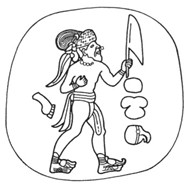
About the Graphic:
Some years ago a unique stone carving was found in the ancient city of La Venta, the Olmec site just east of the Isthmus of Tehuantepec. The face of the stone depicts the figure of a man in the act of traveling, carrying in his left hand a banner or standard. A simple foot glyph confirms that this denotes a journey. Three unknown glyphs are carved below the standard. The archaeologists admit the figure differs in the physical type, as well as clothing, from the Olmecs who built La Venta, and they consider the stone to be of a later period, possibly as late as the first century B.C. They have dubbed it the “messenger” or “The Ambassador” and admit they don’t know what it represents. It could very well reflect Moroni’s call to arms in the name of God, country, and family—three concepts that could possibly be expressed in three simple glyphs. One glyph is a bird head, and the Quetzal bird was a symbol for deity as portrayed in the Quetzalcéatl figure. It is difficult not to associate this carving with the story of Moroni when it not only portrays graphically that incident but is found in the proper area and apparently of the proper period (Simmons, Peoples, Places and Prophecies, 3rd ed. 1986:189-190).
REFERENCES CITED
- Duran, Diego, Fray
- 1971 Book of the Gods and Rites and The Ancient Calendar.
- Translated and edited by Fernando Horcasitas and Doris Heyden. University of Oklahoma Press, Norman.
 Mexico Ministry Support Group
Leave a comment